Meta Description:
New to forex trading? Learn the most important forex trading terms for beginners, with easy explanations, comparison tables, and FAQs to help you start trading confidently.
Introduction
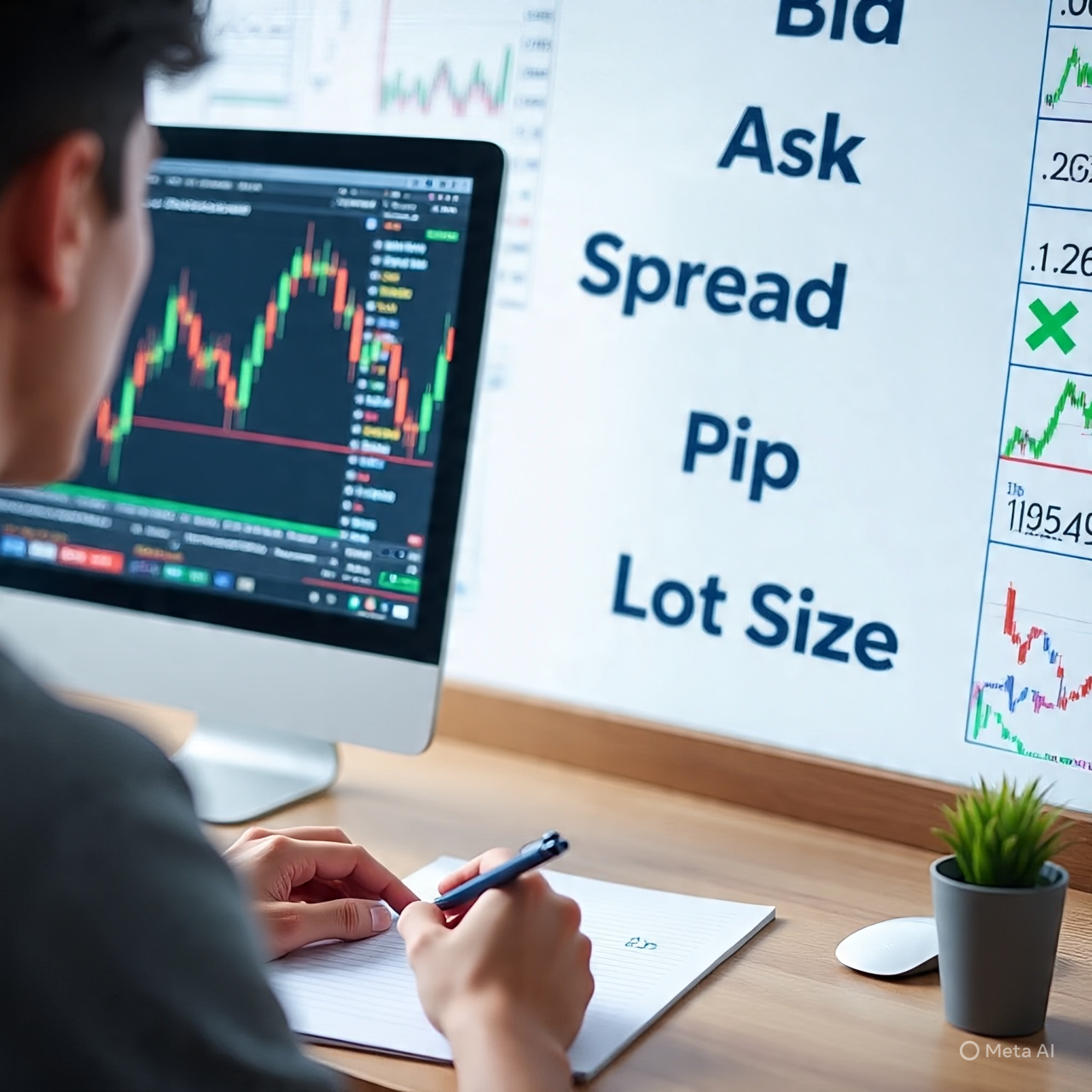
The forex market, also known as the foreign exchange market, is the largest financial market in the world, with a daily trading volume exceeding $7 trillion. For beginners, stepping into this fast-paced market can feel overwhelming—especially with the countless terminologies traders use.
Understanding forex trading terms for beginners is the first step toward building a strong foundation. Without learning these terms, it’s like entering a game without knowing the rules. This guide will break down essential forex terminologies, provide comparisons, and help you gain clarity so you can trade with confidence.
Why Learning Forex Trading Terms is Important
- Improves Decision-Making – Knowing the meaning of terms like “spread” or “pip” helps avoid costly mistakes.
- Boosts Confidence – You’ll understand charts, broker platforms, and analysis tools better.
- Enhances Communication – Enables you to follow forex discussions, news, and strategies easily.
Key Forex Trading Terms for Beginners
Currency Pair
Currencies are traded in pairs (e.g., EUR/USD, GBP/JPY).
- The base currency is the first currency in the pair.
- The quote currency is the second currency.
Example:
If EUR/USD = 1.10, it means 1 Euro equals 1.10 US Dollars.
Major, Minor, and Exotic Pairs
- Major Pairs: Always include the USD (e.g., EUR/USD, USD/JPY).
- Minor Pairs: Do not include the USD but involve strong currencies (e.g., EUR/GBP).
- Exotic Pairs: Include one major currency + a currency from an emerging market (e.g., USD/TRY).
Pip (Percentage in Point)
A pip is the smallest unit of movement in a currency pair.
- Usually, one pip = 0.0001 for most pairs.
- Example: If EUR/USD moves from 1.1000 to 1.1005, that’s a 5 pip move.
Spread
The spread is the difference between the buying (ask) and selling (bid) price of a currency pair.
- Tight spreads = lower trading costs.
- Brokers make profits through spreads.
Leverage
Leverage allows traders to control a larger position with a smaller investment.
- Example: 1:100 leverage means $1 can control $100.
⚠️ Caution: High leverage = higher profits but also higher risks.
Margin
Margin is the minimum amount of money required in your account to open a trade.
- Works together with leverage.
- Example: With 1:100 leverage, a $100 margin can control a $10,000 trade.
Lot Size
Forex is traded in lots:
- Standard Lot: 100,000 units
- Mini Lot: 10,000 units
- Micro Lot: 1,000 units
Bullish vs. Bearish
- Bullish Market: Prices are rising.
- Bearish Market: Prices are falling.
Stop-Loss (SL) and Take-Profit (TP)
- Stop-Loss: Automatically closes a trade to limit losses.
- Take-Profit: Automatically closes a trade when a profit target is reached.
Order Types
- Market Order: Buy/sell instantly at current market price.
- Limit Order: Buy/sell at a specific price level.
- Stop Order: Executes when the market reaches a set level.
Comparison Table: Key Forex Terms
Term Meaning Example
| Pip | Smallest unit of movement in currency price | EUR/USD moves 1.1000 → 1.1001 = 1 pip |
| Spread | Difference between buy & sell price | EUR/USD bid 1.1000 / ask 1.1002 → 2 pips |
| Leverage | Multiplies trading power | 1:100 leverage → $100 = $10,000 |
| Margin | Minimum funds to open a trade | $100 margin to control $10,000 |
| Lot Size | Trading volume in units | Standard lot = 100,000 units |
| SL/TP | Auto-close levels for risk/profit | SL = -$50, TP = +$100 |
Advanced Terms Beginners Should Know
Liquidity
Refers to how easily a currency can be bought/sold without major price changes. Major pairs = high liquidity.
Volatility
Measures how much a currency price fluctuates. High volatility = big risks & big opportunities.
Hedging
A strategy used to protect against potential losses by opening opposite trades.
Trusted External Resources
For more detailed explanations, check out:
FAQs
Q1: What is the most important forex trading term for beginners?
Understanding pips and spreads is crucial since they directly affect profits and costs.
Q2: What does leverage mean in forex?
It allows you to control larger trades with less money but comes with higher risks.
Q3: How much margin is required to start forex trading?
This depends on your broker and leverage, but many brokers allow trading with as little as $100.
Q4: What’s the difference between a market order and a limit order?
A market order executes instantly at the current price, while a limit order waits for a specified price.
Q5: Are forex terms the same across all brokers?
Yes, though some platforms may use slightly different terminology.
Conclusion
Learning the essential forex trading terms for beginners is the first step toward becoming a confident trader. By understanding pips, spreads, leverage, margin, and other terms, you’ll navigate trading platforms more effectively and avoid common mistakes.
Read next: Common Forex Trading Mistakes and How to Avoid Them
'Forex' 카테고리의 다른 글
| Best Free Forex Signal Providers in 2025 (0) | 2025.08.27 |
|---|---|
| Common Forex Trading Mistakes and How to Avoid Them (0) | 2025.08.25 |
| Best forex telegram signals 2025 (1) | 2025.08.15 |
| Withdraw forex profits to Easypaisa (0) | 2025.08.13 |
| What is Leverage in Forex (1) | 2025.08.12 |